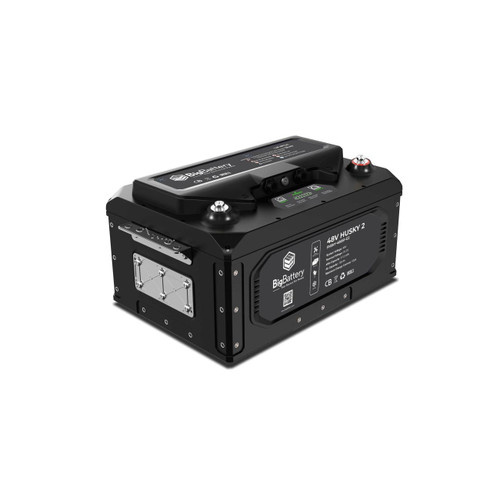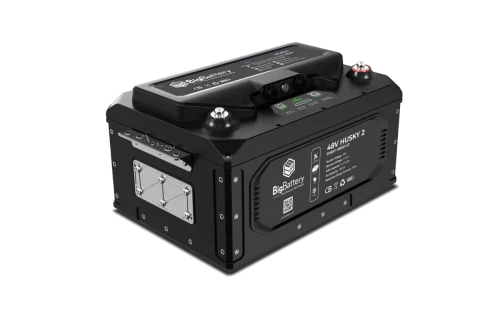


The 72V RAPTOR 2 is a 100Ah LiFePO4 battery built for 72V golf carts, EV UTVs, LSVs, and lead-acid replacement in industrial equipment. It delivers 7.68kWh of usable capacity in a sealed IP65-rated case.
Note: If you would like to review the manufacturer Product Specifications, Warranty, Brochure, etc., for this system, please refer to the "Resources (System Manuals and Warranty)" Tab above on this page.
Field Notes: Why the Specs Matter
This is a LiFePO4 (Lithium Iron Phosphate) battery, not AGM, Gel, or Flooded Lead Acid. That distinction matters for runtime, charging equipment, and depth of discharge. LiFePO4 cells tolerate deeper discharge than lead-acid without the same cycle-life penalty, and they carry a Battery Management System (BMS) that actively protects the pack from over-current, over-voltage, and out-of-range temperature conditions.
At 100Ah and 76.8V nominal, this battery stores 7.68kWh. In practical terms: a 1,000W continuous load draws roughly 13A at this voltage, so the pack can theoretically support that load for several hours before hitting the BMS cutoff, assuming you stay within the recommended discharge range and ambient temperature limits below.
Battery Characteristics
- Chemistry: LiFePO4
- Cell Configuration: 24S
- System Voltage: 72V (76.8V nominal)
- Protection Rating: IP65 / NEMA 4X
- Communications: RS485
Wiring & Configuration Limits
The DATA sheet for this unit does not specify a series or parallel expansion limit. Do not assume this pack can be stacked in series to raise system voltage beyond 72V, or paralleled for added capacity, without manufacturer confirmation. [NEEDS VERIFICATION]
This battery is designed for 72V applications, 72V golf carts, EV UTVs & LSVs, lead-acid replacement, industrial equipment, forklifts, light towers, digital signs, and emergency backup. It is NOT rated as a drop-in 48V-only battery — do not wire it into a 48V system expecting native compatibility without verifying pack voltage matches your application. It is NOT for use as a cranking/starter battery.
Pro-Installer Tip
Charging a LiFePO4 pack below 32°F (0°C) risks lithium plating on the anode, which permanently reduces capacity and can cause internal shorting over time — this is the technical friction most first-time lithium installers overlook. The long-term fix: confirm your charge source respects the stated Charge Temperature Range of 32°F–113°F (0°C–45°C) before every cold-weather charge cycle, since a charge attempt outside that range risks silent cell damage the BMS may not fully prevent. Validate state of charge and pack balance with a shunt-based battery monitor rather than relying on charger LEDs alone. As a professional standard, plan your daily discharge around 80–100% DoD for this chemistry — but stay within the Suggested Low Voltage Cutoff of 72–76.2V rather than running the pack down to the BMS Cutoff Range of 66V–70.5V on a routine basis, which shortens cycle life.
Key Benefits
- Sealed IP65 / NEMA 4X housing for enclosed equipment bays and outdoor-adjacent installs
- Max continuous discharge of 150A supports 7,680W continuous power draw
- 300A peak discharge (5 seconds max) for momentary high-load demands
- RS485 communications for monitoring integration
- Wide discharge temperature range down to -4°F (-20°C)
Technical Table
| Spec | Value |
|---|---|
| System Voltage | 72V |
| Nominal Voltage | 76.8V |
| Chemistry | LiFePO4 |
| Ah Capacity | 100Ah |
| kWh Capacity | 7.68kWh |
| Cell Configuration | 24S |
| Max Continuous Discharge Current | 150A |
| Max Continuous Power | 7680W |
| Max Discharge Peak Current | 300A (Max 5 seconds) |
| Max Charge Current | 100A |
| Charging Voltage Range | 85.2 – 87.6V |
| Max Charge Voltage | 87.6V |
| Operating Voltage Range | 72 – 87.6V |
| Suggested Low Voltage Cutoff | 72 – 76.2V |
| BMS Cutoff Range | 66V – 70.5V |
| Charge Temperature Range | 32°F – 113°F (0°C – 45°C) |
| Discharge Temperature Range | -4°F – 149°F (-20°C – 65°C) |
| Optimal Discharge Temperature Range | 59°F – 95°F (15°C – 35°C) |
| Storage Temperature Range | 23°F – 95°F (-5°C – 35°C) (Max 3 months, SoC >50%) |
| Depth | 15.3 in (389 mm) |
| Width | 34.5 in (876 mm) |
| Height | 7.4 in (188 mm) |
| Weight | 143 lb (64.9 kg) |
| Protection Rating | IP65 / NEMA 4X |
| Communications | RS485 |
Note: See "Resources (System Manuals and Warranty)" Tab above for full specifications.
Compatibility & Fitment
Designed for 72V applications: 72V golf carts, EV UTVs & LSVs, lead-acid replacement, industrial equipment, forklifts, light towers, digital signs, and emergency backup. This pack has an internal BMS with a Max Charge Current of 100A — chargers must stay within the Charging Voltage Range of 85.2–87.6V and respect the Charge Temperature Range of 32°F–113°F (0°C–45°C).
Standard lead-acid chargers are NOT recommended; use a charger matched to this pack's LiFePO4 charge voltage profile. This battery is NOT for use as a starter/cranking battery. Series/parallel expansion limits are not specified in available data — do not wire multiple units together without manufacturer confirmation. [NEEDS VERIFICATION]
Terminal type is not specified in the source data. [NEEDS VERIFICATION]
FAQ
Q: What chemistry is the 72V RAPTOR 2?
A: LiFePO4 (Lithium Iron Phosphate).
Q: Can I use a standard lead-acid charger on this battery?
A: No. Standard lead-acid chargers are not recommended. Use a charger that matches the stated Charging Voltage Range of 85.2 – 87.6V.
Q: What is the maximum continuous discharge current?
A: 150A, supporting up to 7680W of continuous power.
Q: Does this battery have low-temperature charging protection?
A: The Charge Temperature Range is listed as 32°F – 113°F (0°C – 45°C). Whether the BMS includes active cold-weather disconnect or internal heating is not specified in available data. [NEEDS VERIFICATION]
Q: Can this battery be wired in series or parallel with other RAPTOR 2 units?
A: Series/parallel expansion limits are not specified in available manufacturer data for this listing. Confirm with MSSD before wiring multiple units together.
Warranty & Support
Warranty terms for this unit are not included in the provided data. Refer to the "Resources (System Manuals and Warranty)" Tab above for manufacturer warranty documentation. If you have questions about this battery before ordering, ask us — we always reply back.